
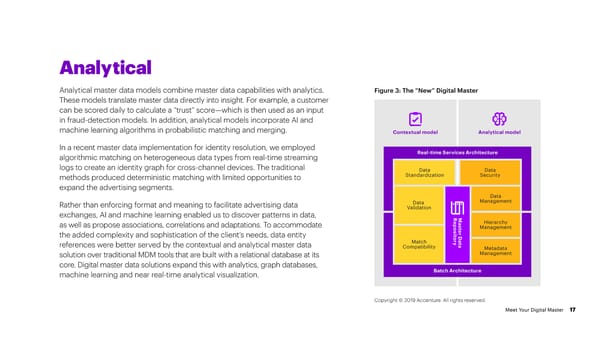
Analytical Analytical master data models combine master data capabilities with analytics. Figure 3: The “New” Digital Master These models translate master data directly into insight. For example, a customer can be scored daily to calculate a “trust” score —which is then used as an input in fraud-detection models. In addition, analytical models incorporate AI and machine learning algorithms in probabilistic matching and merging. Contextual model Analytical model In a recent master data implementation for identity resolution, we employed Real-time Services Architecture algorithmic matching on heterogeneous data types from real-time streaming logs to create an identity graph for cross-channel devices. The traditional Data Data methods produced deterministic matching with limited opportunities to Standardization Security expand the advertising segments. Data Rather than enforcing format and meaning to facilitate advertising data Data Management Validation exchanges, AI and machine learning enabled us to discover patterns in data, ReM as well as propose associations, correlations and adaptations. To accommodate p as Hierarchy o t Management s er i the added complexity and sophistication of the client’s needs, data entity to Da r Match y t references were better served by the contextual and analytical master data Compatibility a Metadata solution over traditional MDM tools that are built with a relational database at its Management core. Digital master data solutions expand this with analytics, graph databases, machine learning and near real-time analytical visualization. Batch Architecture Copyright © 2019 Accenture. All rights reserved. Meet Your Digital Master 17
 Meet Your Digital Master Page 16 Page 18