
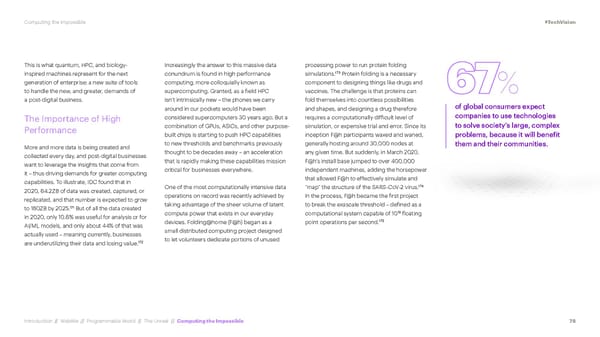
Computing the Impossible #TechVision This is what quantum, HPC, and biology- Increasingly the answer to this massive data processing power to run protein folding 173 inspired machines represent for the next conundrum is found in high performance simulations. Protein folding is a necessary generation of enterprise: a new suite of tools computing, more colloquially known as component to designing things like drugs and to handle the new, and greater, demands of supercomputing. Granted, as a field HPC vaccines. The challenge is that proteins can 67% a post-digital business. isn’t intrinsically new – the phones we carry fold themselves into countless possibilities around in our pockets would have been and shapes, and designing a drug therefore of global consumers expect The Importance of High considered supercomputers 30 years ago. But a requires a computationally difficult level of companies to use technologies Performance combination of GPUs, ASICs, and other purpose- simulation, or expensive trial and error. Since its to solve society’s large, complex built chips is starting to push HPC capabilities inception F@h participants waxed and waned, problems, because it will benefit More and more data is being created and to new thresholds and benchmarks previously generally hosting around 30,000 nodes at them and their communities. collected every day, and post-digital businesses thought to be decades away – an acceleration any given time. But suddenly, in March 2020, want to leverage the insights that come from that is rapidly making these capabilities mission F@h’s install base jumped to over 400,000 it – thus driving demands for greater computing critical for businesses everywhere. independent machines, adding the horsepower capabilities. To illustrate, IDC found that in that allowed F@h to effectively simulate and One of the most computationally intensive data 174 2020, 64.2ZB of data was created, captured, or “map” the structure of the SARS-CoV-2 virus. replicated, and that number is expected to grow operations on record was recently achieved by In the process, F@h became the first project 171 taking advantage of the sheer volume of latent to break the exascale threshold – defined as a to 180ZB by 2025. But of all the data created 18 in 2020, only 10.6% was useful for analysis or for compute power that exists in our everyday computational system capable of 10 floating 175 AI/ML models, and only about 44% of that was devices. Folding@home (F@h) began as a point operations per second. actually used – meaning currently, businesses small distributed computing project designed 172 to let volunteers dedicate portions of unused are underutilizing their data and losing value. Introduction // WebMe // Programmable World // The Unreal // Computing the Impossible 78
 Report Page 77 Page 79