
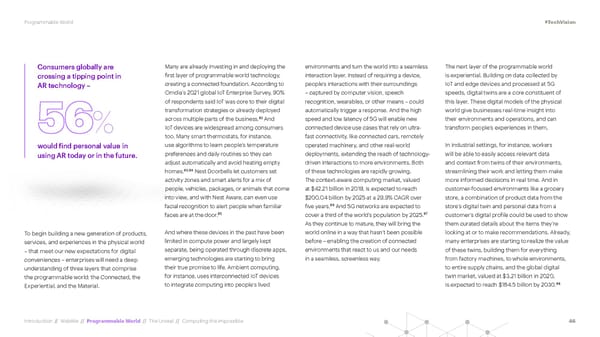
Programmable World #TechVision Consumers globally are Many are already investing in and deploying the environments and turn the world into a seamless The next layer of the programmable world crossing a tipping point in first layer of programmable world technology, interaction layer. Instead of requiring a device, is experiential. Building on data collected by AR technology – creating a connected foundation. According to people’s interactions with their surroundings IoT and edge devices and processed at 5G Omdia’s 2021 global IoT Enterprise Survey, 90% – captured by computer vision, speech speeds, digital twins are a core constituent of of respondents said IoT was core to their digital recognition, wearables, or other means – could this layer. These digital models of the physical transformation strategies or already deployed automatically trigger a response. And the high world give businesses real-time insight into 82 across multiple parts of the business. And speed and low latency of 5G will enable new their environments and operations, and can 56% IoT devices are widespread among consumers connected device use cases that rely on ultra- transform people’s experiences in them. too. Many smart thermostats, for instance, fast connectivity, like connected cars, remotely would find personal value in use algorithms to learn people’s temperature operated machinery, and other real-world In industrial settings, for instance, workers using AR today or in the future. preferences and daily routines so they can deployments, extending the reach of technology- will be able to easily access relevant data adjust automatically and avoid heating empty driven interactions to more environments. Both and context from twins of their environments, 83,84 homes. Nest Doorbells let customers set of these technologies are rapidly growing. streamlining their work and letting them make activity zones and smart alerts for a mix of The context-aware computing market, valued more informed decisions in real time. And in people, vehicles, packages, or animals that come at $42.21 billion in 2019, is expected to reach customer-focused environments like a grocery into view, and with Nest Aware, can even use $200.04 billion by 2025 at a 29.9% CAGR over store, a combination of product data from the 86 facial recognition to alert people when familiar five years. And 5G networks are expected to store’s digital twin and personal data from a 85 87 faces are at the door. cover a third of the world’s population by 2025. customer’s digital profile could be used to show As they continue to mature, they will bring the them curated details about the items they’re To begin building a new generation of products, And where these devices in the past have been world online in a way that hasn’t been possible looking at or to make recommendations. Already, services, and experiences in the physical world limited in compute power and largely kept before – enabling the creation of connected many enterprises are starting to realize the value – that meet our new expectations for digital separate, being operated through discrete apps, environments that react to us and our needs of these twins, building them for everything conveniences – enterprises will need a deep emerging technologies are starting to bring in a seamless, screenless way. from factory machines, to whole environments, understanding of three layers that comprise their true promise to life. Ambient computing, to entire supply chains, and the global digital the programmable world: the Connected, the for instance, uses interconnected IoT devices twin market, valued at $3.21 billion in 2020, Experiential, and the Material. to integrate computing into people’s lived is expected to reach $184.5 billion by 2030.88 Introduction // WebMe // Programmable World // The Unreal // Computing the Impossible 46
 Report Page 45 Page 47