
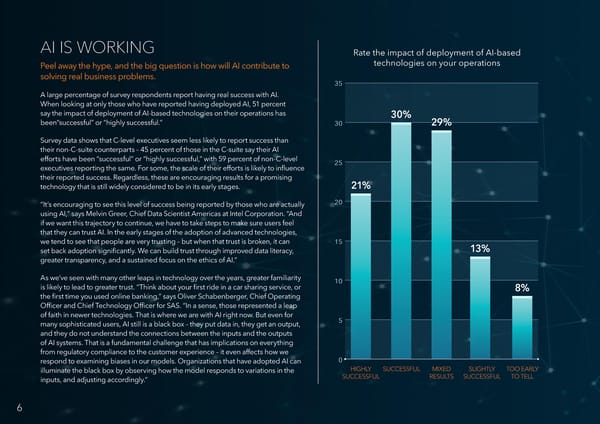
AI IS WORKING Rate the impact of deployment of AI-based Peel away the hype, and the big question is how will AI contribute to technologies on your operations solving real business problems. 35 A large percentage of survey respondents report having real success with AI. When looking at only those who have reported having deployed AI, 51 percent say the impact of deployment of AI-based technologies on their operations has 30% been“successful” or “highly successful.” 30 29% Survey data shows that C-level executives seem less likely to report success than their non-C-suite counterparts – 45 percent of those in the C-suite say their AI efforts have been “successful” or “highly successful,” with 59 percent of non-C-level 25 executives reporting the same. For some, the scale of their efforts is likely to influence their reported success. Regardless, these are encouraging results for a promising 21% technology that is still widely considered to be in its early stages. “It’s encouraging to see this level of success being reported by those who are actually 20 using AI,” says Melvin Greer, Chief Data Scientist Americas at Intel Corporation. “And if we want this trajectory to continue, we have to take steps to make sure users feel that they can trust AI. In the early stages of the adoption of advanced technologies, we tend to see that people are very trusting – but when that trust is broken, it can 15 13% set back adoption significantly. We can build trust through improved data literacy, greater transparency, and a sustained focus on the ethics of AI.” As we’ve seen with many other leaps in technology over the years, greater familiarity 10 is likely to lead to greater trust. “Think about your first ride in a car sharing service, or 8% the first time you used online banking,” says Oliver Schabenberger, Chief Operating Officer and Chief Technology Officer for SAS. “In a sense, those represented a leap of faith in newer technologies. That is where we are with AI right now. But even for 5 many sophisticated users, AI still is a black box – they put data in, they get an output, and they do not understand the connections between the inputs and the outputs of AI systems. That is a fundamental challenge that has implications on everything from regulatory compliance to the customer experience – it even affects how we respond to examining biases in our models. Organizations that have adopted AI can 0 illuminate the black box by observing how the model responds to variations in the HIGHLY SUCCESSFUL MIXED SLIGHTLY TOO EARLY inputs, and adjusting accordingly.” SUCCESSFUL RESULTS SUCCESSFUL TO TELL 6
 AI Momentum, Maturity & Models for Success Page 5 Page 7